Showing posts with label galaxy. Show all posts

Tuesday, February 28, 2012

Ultra-Fast Outflows Help Monster Black Holes Shape Their Galaxies

A curious correlation between the mass of a galaxy's central black hole and the velocity of stars in a vast, roughly spherical structure known as its bulge has puzzled astronomers for years. An international team led by Francesco Tombesi at NASA's Goddard Space Flight Center in Greenbelt, Md., now has identified a new type of black-hole-driven outflow that appears to be both powerful enough and common enough to explain this link.

Most big galaxies contain a central black hole weighing millions of times the sun's mass, but galaxies hosting more massive black holes also possess bulges that contain, on average, faster-moving stars. This link suggested some sort of feedback mechanism between a galaxy's black hole and its star-formation processes. Yet there was no adequate explanation for how a monster black hole's activity, which strongly affects a region several times larger than our solar system, could influence a galaxy's bulge, which encompasses regions roughly a million times larger.
"This was a real conundrum. Everything was pointing to supermassive black holes as somehow driving this connection, but only now are we beginning to understand how they do it," Tombesi said.
Active black holes acquire their power by gradually accreting -- or "feeding" on -- million-degree gas stored in a vast surrounding disk. This hot disk lies within a corona of energetic particles, and while both are strong X-ray sources, this emission cannot account for galaxy-wide properties. Near the inner edge of the disk, a fraction of the matter orbiting a black hole often is redirected into an outward particle jet. Although these jets can hurl matter at half the speed of light, computer simulations show that they remain narrow and deposit most of their energy far beyond the galaxy's star-forming regions.
Astronomers suspected they were missing something. Over the last decade, evidence for a new type of black-hole-driven outflow has emerged. At the centers of some active galaxies, X-ray observations at wavelengths corresponding to those of fluorescent iron show that this radiation is being absorbed. This means that clouds of cooler gas must lie in front of the X-ray source. What's more, these absorbed spectral lines are displaced from their normal positions to shorter wavelengths -- that is, blueshifted, which indicates that the clouds are moving toward us.
In two previously published studies, Tombesi and his colleagues showed that these clouds represented a distinct type of outflow. In the latest study, which appears in the Feb. 27 issue of Monthly Notices of the Royal Astronomical Society, the researchers targeted 42 nearby active galaxies using the European Space Agency's XMM-Newton satellite to hone in on the location and properties of these so-called "ultra-fast outflows" -- or UFOs, for short. The galaxies, which were selected from the All-Sky Slew Survey Catalog produced by NASA's Rossi X-ray Timing Explorer satellite, were all located less than 1.3 billion light-years away.
The outflows turned up in 40 percent of the sample, which suggests that they're common features of black-hole-powered galaxies. On average, the distance between the clouds and the central black hole is less than one-tenth of a light-year. Their average velocity is about 14 percent the speed of light, or about 94 million mph, and the team estimates that the amount of matter required to sustain the outflow is close to one solar mass per year -- comparable to the accretion rate of these black holes.
"Although slower than particle jets, UFOs possess much faster speeds than other types of galactic outflows, which makes them much more powerful," Tombesi explained.
"They have the potential to play a major role in transmitting feedback effects from a black hole into the galaxy at large."
By removing mass that would otherwise fall into a supermassive black hole, ultra-fast outflows may put the brakes on its growth. At the same time, UFOs may strip gas from star-forming regions in the galaxy's bulge, slowing or even shutting down star formation there by sweeping away the gas clouds that represent the raw material for new stars. Such a scenario would naturally explain the observed connection between an active galaxy's black hole and its bulge stars.
Tombesi and his team anticipate significant improvement in understanding the role of ultra-fast outflows with the launch of the Japan-led Astro-H X-ray telescope, currently scheduled for 2014. In the meantime, he intends to focus on determining the detailed physical mechanisms that give rise to UFOs, an important element in understanding the bigger picture of how active galaxies form, develop and grow.

Dwarf Galaxy Questions Current Galaxy Formation Models

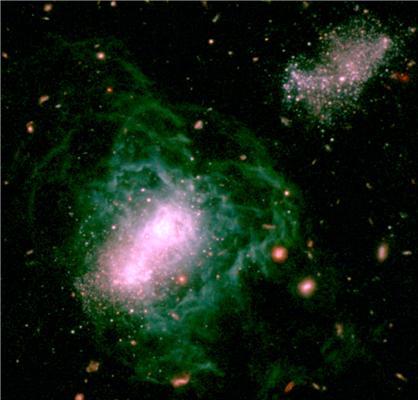
Researcher from the Centro de Astrofísica da Universidade do Porto (Center for Astrophysics of the University of Porto) observed the dwarf galaxy I Zw 18, and found that much of what is known about galaxy formation and evolution might need substantial revision.
CAUP Astronomer Polychronis Papaderos, along with his colleague Göran Östlin (Oskar Klein Center, U. Stokholm), used the Hubble Space Telescope (HST) to get extremely accurate observations of the I Zw 18 galaxy. Their research led to the conclusion that this enigmatic blue compact dwarf might force astronomers to review current galaxy formation models.
I Zw 18 is one of the most studied dwarf galaxies, because among those that have strong star forming activity, it's one of the poorest in heavy elements. Besides, it's proximity to Earth, combined with a total exposure time of nearly 3 days, gave the researchers data with unprecedented resolution and sensitivity.
Analysis of these data revealed an extended gas halo surrounding this galaxy, 16 times larger than the star component of the galaxy, and without any stars. This halo is the result of huge amounts of energy generated by the starburst this galaxy is going through. This energy heats and disturbs I Zw 18's cold gas, which ends up emitting an amount of light comparable to what's being emitted by the stellar component. This emission is designated nebular emission.
Papaderos, a greek astronomer working in Portugal, comments that: "This is ground-breaking work because it provides the first observational proof that, in the early Universe, young galaxies that underwent starbursts must have been surrounded by a huge halo of nebular emission. This extended nebular halo results from the cumulative energetic output from thousands of massive stars exploding as supernovae, shortly after their formation."
So far, in distant galaxies where it's not possible to reach resolutions high enough in order to distinguish between nebular and star emission, it was assumed that the gas occupied the same region as the stars and stars were responsible for emitting most of the light.
This study showed that galaxies undergoing starbursts, similar to I Zw 18, might not obey this rule. This result might lead to substantial corrections in a lot of the work being developed in cosmology and extragalactic astronomy. An example is the estimate of star mass in a galaxy, which is calculated from the galaxies total luminosity. But, as these results shows, up to 50% of that luminosity might originate in nebular, and not star, emission.
Another result from this research shows that, according to Papaderos, "the distribution of nebular emission might be misinterpreted as a stellar disk. These galaxies, still in early stages of formation, might thus be wrongly classified as fully formed galaxies" (such as spirals or ellipticals), a classification mistake that might have happened in many past studies to determine galaxy evolution in the early Universe.
These results are also of importance for our understanding of galaxy formation, because the team concluded that I Zw 18 is extremely young, with most stars younger than 1 billion years. So this galaxy is currently undergoing the dominant phase of its formation, much like the ones formed shortly after the Big Bang.

Saturday, February 18, 2012

Black Hole Came from a Shredded Galaxy


Astronomers using NASA's Hubble Space Telescope have found a cluster of young, blue stars encircling the first intermediate-mass black hole ever discovered. The presence of the star cluster suggests that the black hole was once at the core of a now-disintegrated dwarf galaxy. The discovery of the black hole and the star cluster has important implications for understanding the evolution of supermassive black holes and galaxies.


"For the first time, we have evidence on the environment, and thus the origin, of this middle-weight black hole," said Mathieu Servillat, who worked at the Harvard-Smithsonian Center for Astrophysics when this research was conducted.
Astronomers know how massive stars collapse to form stellar-mass black holes (which weigh about 10 times the mass of our sun), but it's not clear how supermassive black holes (like the four million solar-mass monster at the center of the Milky Way) form in the cores of galaxies. One idea is that supermassive black holes may build up through the merger of smaller, intermediate-mass black holes weighing hundreds to thousands of suns.
Lead author Sean Farrell, of the Sydney Institute for Astronomy in Australia, discovered this unusual black hole in 2009 using the European Space Agency's XMM-Newton X-ray space telescope. Known as HLX-1 (Hyper-Luminous X-ray source 1), the black hole weighs in at 20,000 solar masses and lies towards the edge of the galaxy ESO 243-49, which is 290 million light-years from Earth.
Farrell and his team then observed HLX-1 simultaneously with NASA's Swift observatory in X-ray and Hubble in near-infrared, optical, and ultraviolet wavelengths. The intensity and the color of the light shows a cluster of young stars, 250 light-years across, encircling the black hole. Hubble can't resolve the stars individually because the suspected cluster is too far away. The brightness and color are consistent with other clusters of young stars seen in other galaxies.
Farrell's team detected blue light from hot gas in the accretion disk swirling around the black hole. However, they also detected red light produced by much cooler gas, which would most likely come from stars. Computer models suggested the presence of a young, massive cluster of stars encircling the black hole.
"What we can definitely say with our Hubble data is that we require both emission from an accretion disk and emission from a stellar population to explain the colors we see," said Farrell.
Such young clusters of stars are commonly seen in nearby galaxies, but not outside the flattened starry disk, as found with HLX-1. The best explanation is that the HLX-1 black hole was the central black hole in a dwarf galaxy. The larger host galaxy then captured the dwarf. Most of the dwarf's stars were stripped away through the collision between the galaxies. At the same time, new young stars were formed in the encounter. The interaction that compressed the gas around the black hole also triggered star formation.
Farrell and Servillat found that the star cluster must be less than 200 million years old. This means that the bulk of the stars were formed following the dwarf's collision with the larger galaxy. The age of the stars tells how long ago the two galaxies crashed into each other.
The future of the black hole is uncertain at this stage. It depends on its trajectory, which is currently unknown. It's possible the black hole may spiral in to the center of the big galaxy and eventually merge with the supermassive black hole there. Alternately, the black hole could settle into a stable orbit around the galaxy. Either way, it's likely to fade away in X-rays as it depletes its supply of gas.
"This black hole is unique in that it's the only intermediate-mass black hole we've found so far. Its rarity suggests that these black holes are only visible for a short time," said Servillat.
More observations are planned this year to track the history of the interaction between the two galaxies.
The new findings are being published in the February 15 issue of the Astrophysical Journal Letters.

Friday, February 10, 2012

New Image Captures 'Stealth Merger' of Dwarf Galaxies


The dwarf galaxy NGC 4449 is the first dwarf galaxy with an identified stellar stream (faintly seen at the lower right, and in inset). The star stream represents the remains of a smaller satellite galaxy merging with NGC 4449. The inset image shows the stream resolved into red giant stars. (Credit: Image credit and copyright: R. Jay Gabany (Black Bird Obs.); Insert credit: Subaru/Suprime-Cam (NAOJ))
New images of a nearby dwarf galaxy have revealed a dense stream of stars in its outer regions, the remains of an even smaller companion galaxy in the process of merging with its host. The host galaxy, known as NGC 4449, is the smallest primary galaxy in which a stellar stream from an ongoing merger has been identified and studied in detail.
"This is how galaxies grow. You can see the smaller galaxy coming in and getting shredded, eventually leaving its stars scattered through the halo of the host galaxy," said Aaron Romanowsky, a research astronomer at the University of California, Santa Cruz, and coauthor of a paper on the discovery that has been accepted for publication in Astrophysical Journal Letters. The study was carried out by an international team of astronomers led by David Martínez-Delgado of the Max Planck Institute for Astronomy in Heidelberg.
According to modern cosmological theory, large galaxies were built up from smaller progenitors through a hierarchical process of mergers. Astronomers can see many examples of mergers involving massive galaxies, but mergers of two dwarf galaxies have been hard to find. "We should see the same things at smaller scales, with small galaxies eating smaller ones and so on," Romanowsky said. "Now we have this beautiful image of a dwarf galaxy consuming a smaller dwarf."
NGC 4449 is located 12.5 million light-years from Earth and is a member of a group of galaxies in the constellation Canes Venatici. In size and morphology, it is very similar to one of the Milky Way's satellite galaxies, the Large Magellanic Cloud.
The stellar stream in NGC 4449 was first detected by another group of astronomers as a mysterious, faint smudge in digitized photographic plates from the Digitized Sky Survey project, and it is also visible in archival images from the Sloan Digital Sky Survey. But if it had been just a bit fainter, more diffuse, or farther from the host galaxy, it could easily have been missed. The authors of the new study called it a "stealth merger," where an infalling satellite galaxy is nearly undetectable by conventional means, yet has a substantial influence on its host galaxy.
Martínez-Delgado organized a campaign to follow up on the initial report with more detailed observations. R. Jay GaBany, a Bay Area amateur astronomer and astrophotographer with whom Martínez-Delgado has frequently collaborated, obtained exceptionally deep, wide-field images of NGC 4449 with the half-meter Black Bird Observatory telescope (located in the Sierra Nevada mountains). Those images confirmed the presence of a faint substructure in the halo of the galaxy. Romanowsky, along with UCSC graduate student Jacob Arnold, then used the 8.2-meter Subaru Telescope in Hawaii to obtain high-resolution images in which the individual stars in the stellar stream can be seen.
"I don't think I'd ever seen a picture of a galaxy merger where you can see the individual stars," Romanowsky said. "It's really an impressive image."
The new observations support the idea that the stellar haloes around many dwarf galaxies are the remnants of smaller satellites that were shredded in past merger events. The ongoing merger in NGC 4449 may also be responsible for the intense burst of star formation seen in the galaxy. "This galaxy is famous for its starburst activity, and it seems we've found the reason for that. The gravitational interaction of the incoming galaxy has probably disturbed the gas in the main galaxy and caused it to start forming stars," Romanowsky said.
The companion galaxy was also independently discovered by a team of scientists led by UCLA astronomer Michael Rich. Their study, based on images obtained by the Centurion 28-inch telescope located at the Polaris Observatory Association near Frazier Park, California, will be published in the February 9 issue of Nature.
In addition to Martínez-Delgado, Romanowsky, Arnold, and GaBany, the coauthors of the Astrophysical Journal Letters paper include Jean Brody, professor of astronomy and astrophysics at UC Santa Cruz; Francesca Annibali at the Astronomical Observatory of Bologna; Jurgen Fliri at the Observatory of Paris; Stefano Zibetti at the University of Copenhagen; Roeland van der Marel and Alessandra Aloisi at the Space Telescope Science Institute; Hans-Walter Rix and Andrea Maccio at the Max Planck Institute; Taylor Chonis at the University of Texas, Austin; Julio Carballo-Bello at the Canary Astrophysics Institute; J. Gallego-Laborda at Fosca Nit Observatory in Spain; and Michael Merrifield at the University of Nottingham, England.
This research was supported by the National Science Foundation, NASA, and the UCSC-UARC Aligned Research Program.
The above story is reprinted from materials provided by University of California - Santa Cruz. The original article was written by Tim Stephens. 

NASA's Galaxy Evolution Explorer in Standby Mode


NASA's Galaxy Evolution Explorer, or Galex, was placed in standby mode Feb. 7, 2012 as engineers prepare to end mission operations, nearly nine years after the telescope's launch. The spacecraft is scheduled to be decommissioned -- taken out of service -- later this year. The mission extensively mapped large portions of the sky with sharp ultraviolet vision, cataloguing millions of galaxies spanning 10 billion years of cosmic time.
The Galaxy Evolution Explorer launched into space from a Pegasus XL rocket in April of 2003. Since completing its prime mission in the fall of 2007, the mission was extended to continue its census of stars and galaxies.
The mission's science highlights include the discovery of a gigantic comet-like tail behind a speeding star, rings of new stars around old galaxies, and "teenager" galaxies, which help to explain how galaxies evolve. The observatory also helped confirm the existence of the mysterious substance or force known as dark energy, and even caught a black hole devouring a star.
The California Institute of Technology, Pasadena, Calif., leads the Galaxy Evolution Explorer mission and is responsible for science operations and data analysis. NASA's Jet Propulsion Laboratory, also in Pasadena, manages the mission and built the science instrument. The mission was developed under NASA's Explorers Program, managed by the Goddard Space Flight Center, Greenbelt, Md. Researchers sponsored by Yonsei University in South Korea and the Centre National d'Etudes Spatiales (CNES) in France collaborated on this mission. Caltech manages JPL for NASA.
Graphics and additional information about the Galaxy Evolution Explorer are online at http://www.nasa.gov/galex/ and http://www.galex.caltech.edu/ .

Wednesday, February 8, 2012

New Image Captures 'Stealth Merger' of Dwarf Galaxies


New images of a nearby dwarf galaxy have revealed a dense stream of stars in its outer regions, the remains of an even smaller companion galaxy in the process of merging with its host. The host galaxy, known as NGC 4449, is the smallest primary galaxy in which a stellar stream from an ongoing merger has been identified and studied in detail.
"This is how galaxies grow. You can see the smaller galaxy coming in and getting shredded, eventually leaving its stars scattered through the halo of the host galaxy," said Aaron Romanowsky, a research astronomer at the University of California, Santa Cruz, and coauthor of a paper on the discovery that has been accepted for publication in Astrophysical Journal Letters. The study was carried out by an international team of astronomers led by David Martínez-Delgado of the Max Planck Institute for Astronomy in Heidelberg.
According to modern cosmological theory, large galaxies were built up from smaller progenitors through a hierarchical process of mergers. Astronomers can see many examples of mergers involving massive galaxies, but mergers of two dwarf galaxies have been hard to find. "We should see the same things at smaller scales, with small galaxies eating smaller ones and so on," Romanowsky said. "Now we have this beautiful image of a dwarf galaxy consuming a smaller dwarf."
NGC 4449 is located 12.5 million light-years from Earth and is a member of a group of galaxies in the constellation Canes Venatici. In size and morphology, it is very similar to one of the Milky Way's satellite galaxies, the Large Magellanic Cloud.
The stellar stream in NGC 4449 was first detected by another group of astronomers as a mysterious, faint smudge in digitized photographic plates from the Digitized Sky Survey project, and it is also visible in archival images from the Sloan Digital Sky Survey. But if it had been just a bit fainter, more diffuse, or farther from the host galaxy, it could easily have been missed. The authors of the new study called it a "stealth merger," where an infalling satellite galaxy is nearly undetectable by conventional means, yet has a substantial influence on its host galaxy.
Martínez-Delgado organized a campaign to follow up on the initial report with more detailed observations. R. Jay GaBany, a Bay Area amateur astronomer and astrophotographer with whom Martínez-Delgado has frequently collaborated, obtained exceptionally deep, wide-field images of NGC 4449 with the half-meter Black Bird Observatory telescope (located in the Sierra Nevada mountains). Those images confirmed the presence of a faint substructure in the halo of the galaxy. Romanowsky, along with UCSC graduate student Jacob Arnold, then used the 8.2-meter Subaru Telescope in Hawaii to obtain high-resolution images in which the individual stars in the stellar stream can be seen.
"I don't think I'd ever seen a picture of a galaxy merger where you can see the individual stars," Romanowsky said. "It's really an impressive image."
The new observations support the idea that the stellar haloes around many dwarf galaxies are the remnants of smaller satellites that were shredded in past merger events. The ongoing merger in NGC 4449 may also be responsible for the intense burst of star formation seen in the galaxy. "This galaxy is famous for its starburst activity, and it seems we've found the reason for that. The gravitational interaction of the incoming galaxy has probably disturbed the gas in the main galaxy and caused it to start forming stars," Romanowsky said.
The companion galaxy was also independently discovered by a team of scientists led by UCLA astronomer Michael Rich. Their study, based on images obtained by the Centurion 28-inch telescope located at the Polaris Observatory Association near Frazier Park, California, will be published in the February 9 issue of Nature.
In addition to Martínez-Delgado, Romanowsky, Arnold, and GaBany, the coauthors of the Astrophysical Journal Letters paper include Jean Brody, professor of astronomy and astrophysics at UC Santa Cruz; Francesca Annibali at the Astronomical Observatory of Bologna; Jurgen Fliri at the Observatory of Paris; Stefano Zibetti at the University of Copenhagen; Roeland van der Marel and Alessandra Aloisi at the Space Telescope Science Institute; Hans-Walter Rix and Andrea Maccio at the Max Planck Institute; Taylor Chonis at the University of Texas, Austin; Julio Carballo-Bello at the Canary Astrophysics Institute; J. Gallego-Laborda at Fosca Nit Observatory in Spain; and Michael Merrifield at the University of Nottingham, England.

The dwarf galaxy NGC 4449 is the first dwarf galaxy with an identified stellar stream (faintly seen at the lower right, and in inset). The star stream represents the remains of a smaller satellite galaxy merging with NGC 4449. The inset image shows the stream resolved into red giant stars. (Credit: Image credit and copyright: R. Jay Gabany (Black Bird Obs.); Insert credit: Subaru/Suprime-Cam (NAOJ))

The above story is reprinted from materials provided by University of California - Santa Cruz. The original article was written by Tim Stephens. 

Monday, February 6, 2012

Hubble Zooms in On a Magnified Galaxy


Thanks to the presence of a natural "zoom lens" in space, NASA's Hubble Space Telescope got a uniquely close-up look at the brightest "magnified" galaxy yet discovered. This observation provides a unique opportunity to study the physical properties of a galaxy vigorously forming stars when the universe was only one-third its present age.
A so-called gravitational lens is produced when space is warped by a massive foreground object, whether it is the Sun, a black hole, or an entire cluster of galaxies. The light from more-distant background objects is distorted, brightened, and magnified as it passes through this gravitationally disturbed region.
A team of astronomers led by Jane Rigby of NASA's Goddard Space Flight Center in Greenbelt, Md., aimed Hubble at one of the most striking examples of gravitational lensing, a nearly 90-degree arc of light in the galaxy cluster RCS2 032727-132623. Hubble's view of the distant background galaxy is significantly more detailed than could ever be achieved without the help of the gravitational lens.
The results were recently published in The Astrophysical Journal, in a paper led by Keren Sharon of the Kavli Institute for Cosmological Physics at the University of Chicago. Professor Michael Gladders and graduate student Eva Wuyts of the University of Chicago were also key team members.
The presence of the lens helps show how galaxies evolved from 10 billion years ago to today. While nearby galaxies are fully mature and are at the tail end of their star-formation histories, distant galaxies tell us about the universe's formative years. The light from those early events is just now arriving at Earth. Very distant galaxies are not only faint but also appear small on the sky. Astronomers would like to see how star formation progressed deep within these galaxies. Such details would be beyond the reach of Hubble's vision were it not for the magnification made possible by gravity in the intervening lens region.
In 2006 a team of astronomers using the Very Large Telescope in Chile measured the arc's distance and calculated that the galaxy appears over three times brighter than previously discovered lensed galaxies. In 2011 astronomers used Hubble to image and analyze the lensed galaxy with the observatory's Wide Field Camera 3.
The distorted image of the galaxy is repeated several times in the foreground lensing cluster, as is typical of gravitational lenses. The challenge for astronomers was to reconstruct what the galaxy really looked like, were it not distorted by the cluster's funhouse-mirror effect.
Hubble's sharp vision allowed astronomers to remove the distortions and reconstruct the galaxy image as it would normally look. The reconstruction revealed regions of star formation glowing like bright Christmas tree bulbs. These are much brighter than any star-formation region in our Milky Way galaxy.
Through spectroscopy, the spreading out of light into its constituent colors, the team plans to analyze these star-forming regions from the inside out to better understand why they are forming so many stars.

 Thanks to the presence of a natural "zoom lens" in space, this is a close-up look at the brightest distant "magnified" galaxy in the universe known to date. It is one of the most striking examples of gravitational lensing, where the gravitational field of a foreground galaxy bends and amplifies the light of a more distant background galaxy. In this image the light from a distant galaxy, nearly 10 billion light-years away, has been warped into a nearly 90-degree arc of light in the galaxy cluster RCS2 032727-132623. The galaxy cluster lies 5 billion light-years away. The background galaxy's image is over three times brighter than typically lensed galaxies. (Credit: NASA, ESA, J. Rigby (NASA Goddard Space Flight Center), K. Sharon (Kavli Institute for Cosmological Physics, University of Chicago), and M. Gladders and E. Wuyts (University of Chicago))

The above story is reprinted from materials provided by Space Telescope Science Institute (STScI), via Newswise. 

Classic Portrait of a Barred Spiral Galaxy


The NASA/ESA Hubble Space Telescope has taken a picture of the barred spiral galaxy NGC 1073, which is found in the constellation of Cetus (The Sea Monster). Our own galaxy, the Milky Way, is a similar barred spiral, and the study of galaxies such as NGC 1073 helps astronomers learn more about our celestial home.
Most spiral galaxies in the Universe have a bar structure in their centre, and Hubble's image of NGC 1073 offers a particularly clear view of one of these. Galaxies' star-filled bars are thought to emerge as gravitational density waves funnel gas toward the galactic centre, supplying the material to create new stars. The transport of gas can also feed the supermassive black holes that lurk in the centres of almost every galaxy.
Some astronomers have suggested that the formation of a central bar-like structure might signal a spiral galaxy's passage from intense star-formation into adulthood, as the bars turn up more often in galaxies full of older, red stars than younger, blue stars. This storyline would also account for the observation that in the early Universe, only around a fifth of spiral galaxies contained bars, while more than two thirds do in the more modern cosmos.
While Hubble's image of NGC 1073 is in some respects an archetypal portrait of a barred spiral, there are a couple of quirks worth pointing out.
One, ironically, is almost -- but not quite -- invisible to optical telescopes like Hubble. In the upper left part of the image, a rough ring-like structure of recent star formation hides a bright source of X-rays. Called IXO 5, this X-ray source is likely to be a binary system featuring a black hole and a star orbiting each other. Comparing X-ray observations from the Chandra spacecraft with this Hubble image, astronomers have narrowed the position of IXO 5 down to one of two faint stars visible here. However, X-ray observations with current instruments are not precise enough to conclusively determine which of the two it is.
Hubble's image does not only tell us about a galaxy in our own cosmic neighbourhood, however. We can also discern glimpses of objects much further away, whose light tells us about earlier eras in cosmic history.
Right across Hubble's field of view, more distant galaxies are peering through NGC 1073, with several reddish examples appearing clearly in the top left part of the frame.
More intriguing still, three of the bright points of light in this image are neither foreground stars from the Milky Way, nor even distant stars in NGC 1073. In fact they are not stars at all. They are quasars, incredibly bright sources of light caused by matter heating up and falling into supermassive black holes in galaxies literally billions of light-years from us. The chance alignment through NGC 1073, and their incredible brightness, might make them look like they are part of the galaxy, but they are in fact some of the most distant objects observable in the Universe.

The NASA/ESA Hubble Space Telescope has taken a picture of the barred spiral galaxy NGC 1073, which is found in the constellation of Cetus (The Sea Monster). Our own galaxy, the Milky Way, is thought to be a similar barred spiral, and the study of galaxies such as NGC 1073 can help astronomers learn more about our celestial home. (Credit: NASA & ESA)

The above story is reprinted from materials provided by ESA/Hubble Information Centre.